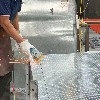
In projects such as chemical plants, pharmaceutical facilities, power storage stations, and data centers, the choice of materials for explosion-proof and fire-resistant walls directly impacts the overall safety rating of the project. Many overseas procurement teams initially opt for traditional brick walls or standard single-layer fire-resistant boards, only to encounter issues during on-site installation. Brick walls are excessively heavy, increasing the load on the building's main structure, and require long construction periods; standard fire-resistant boards often lack impact resistance, making them prone to shattering or detaching under explosive shockwaves-failing to meet the safety standards required for high-risk facilities. Addressing these pain points, an increasing number of general contractors and design institutes are selecting fiber-cement composite steel panels as the preferred material for explosion-proof and fire-resistant partition walls.
Fiber-cement composite steel panels are high-performance composite boards featuring a sandwich structure, formed by integrating galvanized steel sheets on both sides with a fiber-cement core through a high-pressure bonding process. Simply put, they combine the impact toughness of steel with the excellent fire resistance and energy-absorbing properties of the fiber-cement core. The surface steel sheets undergo a punching and interlocking treatment to bond securely with the cement core, effectively preventing common issues such as delamination or hollow spots. While standard versions utilize hot-dip galvanized steel, options with stainless steel facings are available for humid environments to further enhance corrosion resistance. The core material-composed of cement, alkali-resistant glass fiber, and mineral fillers-is cured under high temperature and pressure; it is classified as an A1-grade non-combustible inorganic material that emits no toxic fumes during combustion.
These panels are available in various specifications to meet specific project requirements. The most common thickness is 9.5 mm, with thicker options (such as 12 mm and 15 mm) also available; they offer fire resistance ratings of 2 to 4 hours, satisfying diverse project standards. The panels feature a smooth surface and precise dimensions, allowing for on-site cutting and drilling. They are compatible with dry-assembly methods using framing systems, eliminating the need for wet-trade plastering. Compared to traditional masonry walls, these panels are significantly lighter, reducing the load on building foundations-a feature particularly advantageous for renovation projects.
Surface finishes and treatment solutions can also be customized. The galvanized surface offers inherent rust resistance, but powder coating can be applied to enhance acid and alkali resistance, making the panels suitable for corrosive environments such as chemical processing workshops. The cut edges of the panels can be sealed to prevent the core material from absorbing moisture. When used with a system comprising steel framing, sealing strips, and mounting hardware, the assembly forms a stable structure that prevents widespread debris scattering during a blast-a critical safety feature for explosion-proof walls.
These panels are utilized across a wide range of specialized engineering sectors. In industrial safety, they are used to construct explosion-proof partitions and pressure-relief walls in petrochemical plants, pharmaceutical workshops, hazardous chemical warehouses, and energy storage stations to withstand accidental impacts. In the power sector, they provide fire-resistant cladding and partitions for substations, generator rooms, and cable tunnels, leveraging their superior fire resistance to halt the spread of fire. Data centers and server rooms employ them for fire compartmentalization and sound insulation, addressing both fire safety and noise reduction needs. They are also widely used for fire protection in basements, tunnels, and ventilation ducts within public buildings. For highly corrosive environments-such as offshore platforms and chemical laboratories-versions with stainless steel facings are available.
Many overseas general contractors value our flexible customization capabilities. Beyond offering standard stock sizes, we can adjust panel dimensions (length, width, and thickness) and modify the steel facing material or anti-corrosion surface treatments based on project blueprints. We ensure reliable delivery-whether for initial sample shipments, small-batch trial orders, or large-scale project supplies-to align with overseas construction schedules.
Before shipment, every batch undergoes random inspections for appearance and performance, verifying bonding quality and flatness; we also provide corresponding test reports to facilitate local project approval processes. The panels are palletized and moisture-proofed, making them suitable for long-distance ocean transport. If you are looking for specialized composite panels that offer A1-rated fire resistance, blast impact resistance, and ease of rapid installation, please contact us for samples, technical specifications, and project quotations.