


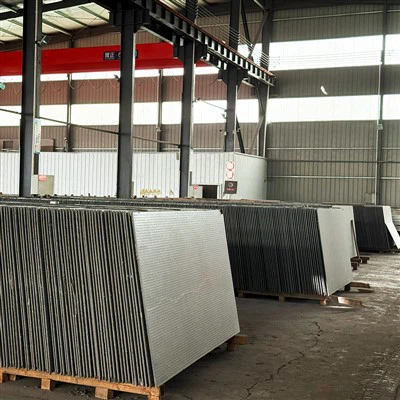
Non-flammable Fiber Cement Composite Steel Plate
Non-flammable fiber cement composite steel plate has a Class A fire rating and a fire resistance limit of ≥3 hours. It meets the requirements for overpressure, explosion resistance, and impact resistance of 200 kN/m². Its perforated upper and lower galvanized steel plates with a fiber-cement core layer are widely used in firewalls, explosion-proof walls, and public buildings with high safety and durability requirements. Non-flammable fiber cement composite steel plate is inherently non-combustible, providing excellent fire resistance during use. Even in the event of a fire, it will not burn. The two outer galvanized steel plates provide a certain degree of flame resistance, primarily slowing the spread of fire and buying valuable time for firefighters.
Many fires occur due to inadequate attention. Choosing non-flammable fiber cement composite steel plate for fire walls, a material with exceptional fire resistance, can prevent fires before they occur. Even if a fire does occur, its spread can be prevented. Compared to ordinary steel plates, the cement layer provides both thermal insulation and structural support, meeting the three fire resistance requirements of integrity, thermal insulation, and load-bearing capacity during a fire. The cement layer of non-flammable fiber cement composite steel plates is primarily made of Portland cement, blended with quartz sand, alkali-resistant glass fiber, and a small amount of inorganic additives. All ingredients are non-combustible. The cement and quartz sand are primarily composed of inorganic compounds such as CaSiO₃ and SiO₂. At high temperatures, they undergo only physical changes and do not produce combustible gases or flames. Alkali-resistant glass fiber, on the other hand, has a melting point of 800-1000°C, far exceeding the temperature of ordinary fires. Furthermore, it does not burn and does not release toxic substances.
Although both are non-flammable fiber cement composite steel plates, their non-combustibility properties vary. What factors influence this non-combustibility?
Purity of cement materials:
During production, the addition of organic combustible additives, such as plastic fibers and asphalt, is strictly prohibited. These additives can cause combustion and smoke release at high temperatures, thereby reducing the non-combustibility rating.
Surface treatment:
During production or application, organic topcoats are sometimes applied to the surface for aesthetic reasons. Organic topcoats are combustible materials and can burn and produce flames in high-temperature environments. While this does not affect the inherent non-combustibility of the material, it can reduce its overall non-combustibility.
The non-combustibility properties of non-flammable fiber cement composite steel plates are a combination of the inherent non-combustibility of the inorganic core layer and the structural protection of the metal faceplate. In a fire, they remain non-combustible, non-combustible, and produce no toxic smoke or flammable droplets. They are the preferred material for fire barriers in high-risk industrial environments and core equipment areas in crowded public spaces.
Maintenance and care for non-flammable fiber cement composite steel plates are designed to extend their service life and maintain fire resistance and structural stability. These maintenance procedures include daily inspections, regular maintenance, special case handling, and troubleshooting.
Daily Inspection:
Observe the surface for rust, scratches, or coating peeling. Check the joints for cracked or flaky sealant, and for bulges, deformation, or chalking. Repair any problems promptly.
Regular Maintenance:
Sand and remove rust from localized rusted areas until the natural metal color is exposed. Apply an inorganic zinc-rich primer. If used in a humid environment, apply fire-retardant sealant to the joints annually. Replace aging components regularly.
Special Applications:
This primarily applies to non-flammable fiber cement composite steel panels used in coastal, chemical, and high-temperature environments. These panels require appropriate maintenance and care.
Troubleshooting:
If signs of rust, moisture in the core layer, or leakage at joints occur, repair them promptly. If repair is not possible, replace with a new panel.


Hot Tags: non-flammable fiber cement composite steel plate, China non-flammable fiber cement composite steel plate manufacturers, suppliers, factory, 9 5 Thick Fiber Cement Composite Steel Plate, Fiber Cement Composite Steel Plate for Elevators, Fiber Cement Composite Steel Plate for Escape Tunnels, Fire Resistant Blastproof Steel Cement Boards, Non flammable Fiber Cement Composite Steel Plate, Waterproof Fiber Cement Composite Steel Plate
You Might Also Like



Send Inquiry