


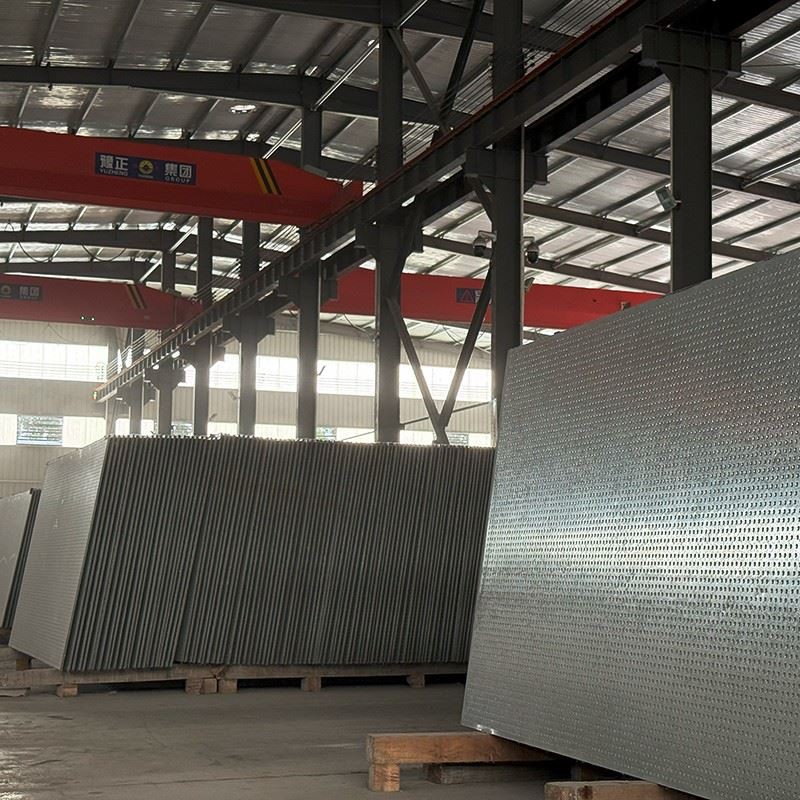


Fiber Cement Composite Steel Plate for Load Bearing
The load-bearing capacity of fiber cement composite steel plate for load bearing primarily stems from the tensile ductility of the steel plates and the compressive stiffness of the fiber cement layer, making them particularly suitable for medium-to-low load scenarios. Fiber cement composite steel plate for load bearing utilize a sandwich structure of galvanized steel plates, fiber cement layers, and galvanized steel plates. Under concentrated loads, the ultimate load-bearing capacity can be significantly improved by adjusting the steel plate thickness and fiber content. During production, spraying or vibration compaction processes ensure uniform distribution of the steel fibers within the cement matrix, avoiding localized strength defects. Curing for seven days at a temperature ≥20°C and a humidity ≥90% effectively improves the density of the fiber cement layer.
Since the primary performance of fiber cement composite steel plate for load bearing lies in their load-bearing capacity, how do we test their load-bearing capacity when purchasing them?
We require flexural strength testing, compressive strength testing, and bond strength testing. Of course, users may not be aware of how these tests are performed. As a professional manufacturer, we conduct pre-shipment testing on our customers to ensure that every product is of qualified quality.
We also conduct simple tests to verify the structural integrity of fiber cement composite steel plate for load bearing before use. We use a 2kg steel ball to drop freely from a height of 1m to observe whether the panel cracks or deforms, thereby assessing its impact resistance. We use acoustic reflection to locate internal bonding or delamination defects, ensuring that the composite structure is free of interfacial failure.
I recently participated in an industrial renovation project and discovered the benefits of using fiber cement composite steel plate for load bearing. Many areas in industrial renovation projects require support. When constructing new platforms, using fiber cement composite steel plate for load bearing of a specific thickness, combined with a suitable support structure, can support large equipment weighing several tons without damage during long-term use. Compared to traditional panels, they can be thinner while maintaining the same load-bearing capacity, effectively saving space. This is particularly helpful for two-story storage platforms, which need to meet cargo storage needs while not disrupting production processes.
Industrial production often generates loud noise, a significant headache for nearby residents. Prolonged construction can also lead to complaints, creating a pressing issue for construction workers.Fiber cement composite steel plate for load bearing offer excellent sound and heat insulation. As partition materials, they effectively reduce noise transmission, providing a quiet and comfortable environment for surrounding offices and residential areas.
For areas requiring insulation, such as boiler room exterior wall renovations, low thermal conductivity can reduce heat transfer, helping to maintain indoor temperature stability, improve energy efficiency, and reduce production costs.
Thus, fiber cement composite steel plate for load bearing offer high-quality solutions for building construction, from structural strength to fire and corrosion resistance, and hold broad application prospects.


Hot Tags: fiber cement composite steel plate for load bearing, China fiber cement composite steel plate for load bearing manufacturers, suppliers, factory, Fiber Cement and Steel Composite Board, Fiber Cement Composite Panel, Fire Protection Impact Board, Fireproof Fiber Cement Composite Steel Plate, Impact resistant Fiber Cement Composite Steel Plate, Punching Fiber Cement Composite Steel Plate
You Might Also Like


Send Inquiry